
TablePro 0.70: Follow a Foreign Key Without Writing the Join
TablePro Team
On this page
TablePro 0.70 is out: 58 changes, 31 of them fixes.
Most of it lands in three places: reading a row, querying MongoDB, and moving columns around.
The row as JSON
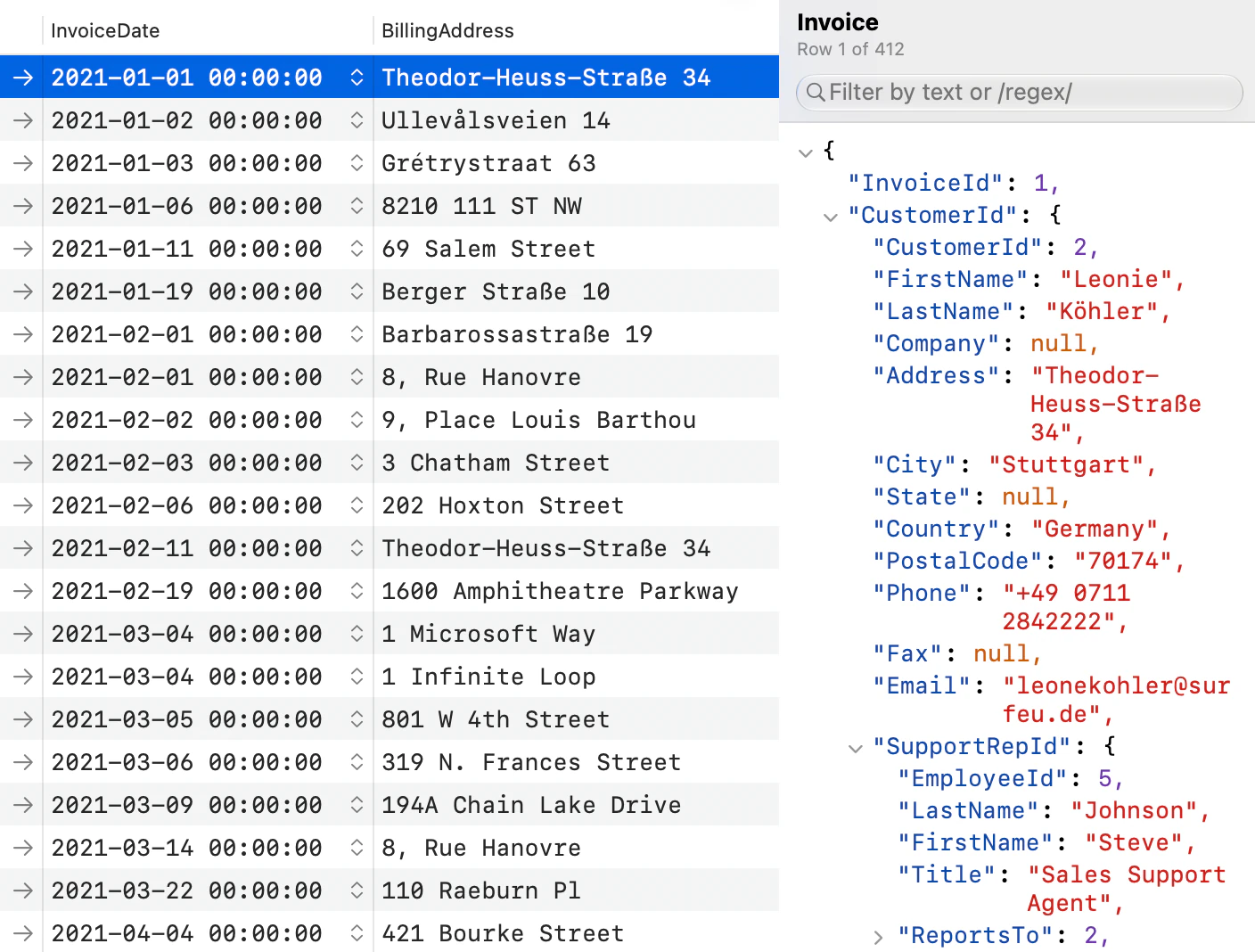
#The inspector gains a JSON tab. It shows the selected row as formatted JSON, and Show Row as JSON on a row's right-click menu opens it directly.
The part worth having is the foreign keys. Click one and TablePro fetches the row it references and expands it inline, so you read the order, its customer and that customer's country without leaving the grid or writing a join. It follows a chain five levels deep.
A row that references itself is ordinary schema design, so the chain is checked rather than trusted: employee.manager_id → employee would otherwise expand forever. TablePro stops on a repeat and says so on the node.
Always Expand Foreign Keys turns off the first click. It fetches one level, not five, because the setting exists to save a click and not to walk your schema on every selection change.
The filter field above the tree takes plain text, or a regular expression if you wrap it in slashes.
A JavaScript shell for MongoDB
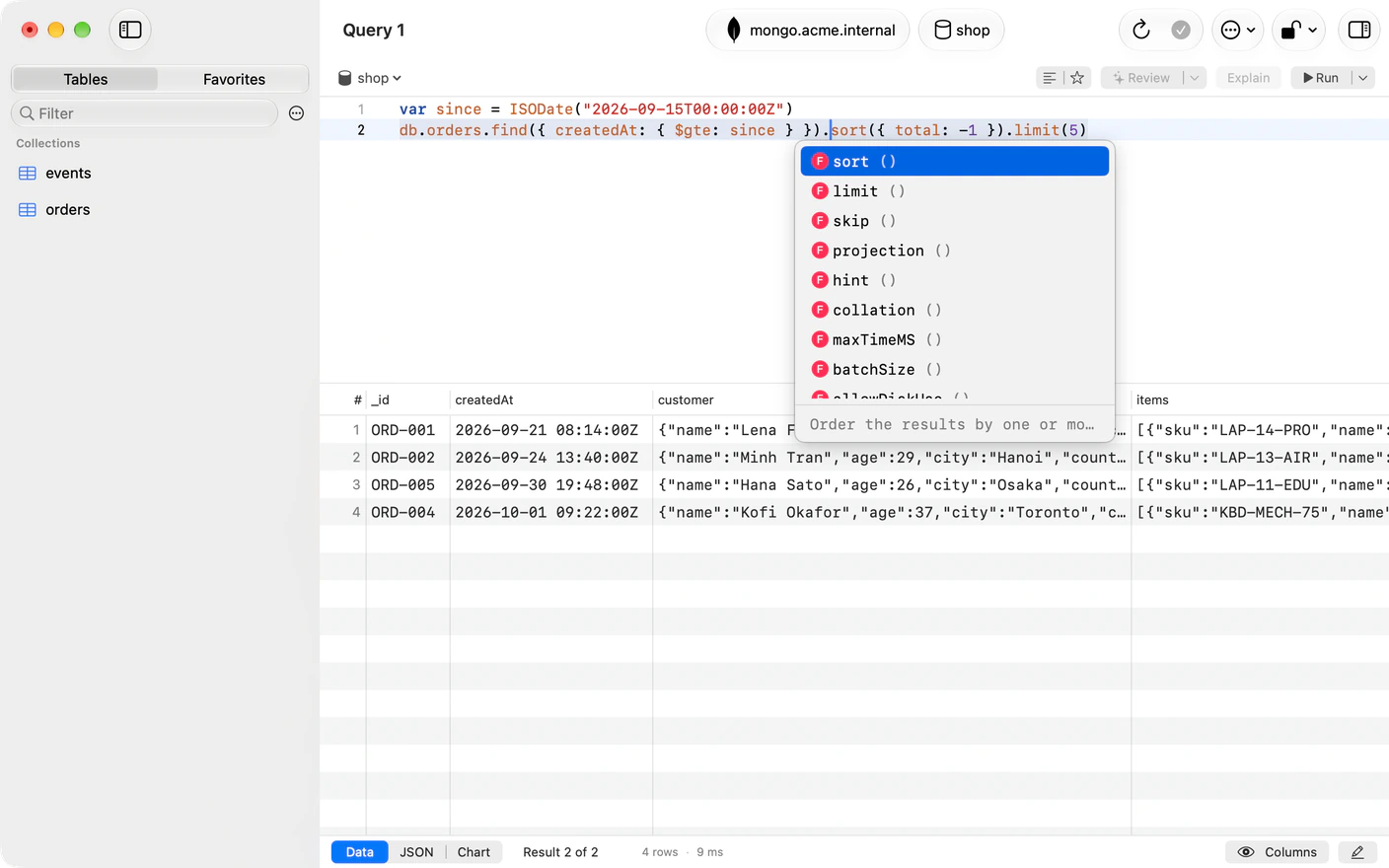
#MongoDB queries in TablePro used to be parsed as a filter document. Now they run as JavaScript, with the db API you already use in mongosh: collections, cursors, var, functions, and print.
var cutoff = new Date("2026-01-01");
db.orders.find({ created: { $gt: cutoff } }).sort({ total: -1 }).limit(20)
Each connection keeps its own runtime, so cutoff is still there in the next statement, exactly as it is in a shell. use switches the database the same way. Autocomplete offers the cursor methods after find() and aggregate().
Documents cross into the shell as JSON text rather than as rebuilt objects, because BSON field order decides how an embedded document compares and where _id sits, and a document rebuilt from a dictionary comes back reordered.
Two side effects of the change: a script is split into the top-level statements of a JavaScript program rather than at semicolons, so a semicolon inside a function body no longer cuts a query in half, and the editor's diagnostics report JavaScript syntax errors instead of complaining about method names it did not recognise.
Column reorder
#Drag a column in the structure editor to move it. What runs underneath depends on what the engine has.
MySQL, MariaDB and ClickHouse have MODIFY COLUMN … FIRST | AFTER, so the catalog is rewritten and no row is read or written. Oracle has no positional clause at all, but cycling a column invisible and back moves it to the end, and that composes into any order you want.
PostgreSQL, SQLite, libSQL, Turso and Cloudflare D1 have nothing positional. The order changes by recreating the table and copying the rows into it, so TablePro shows you the whole script and waits before running any of it.
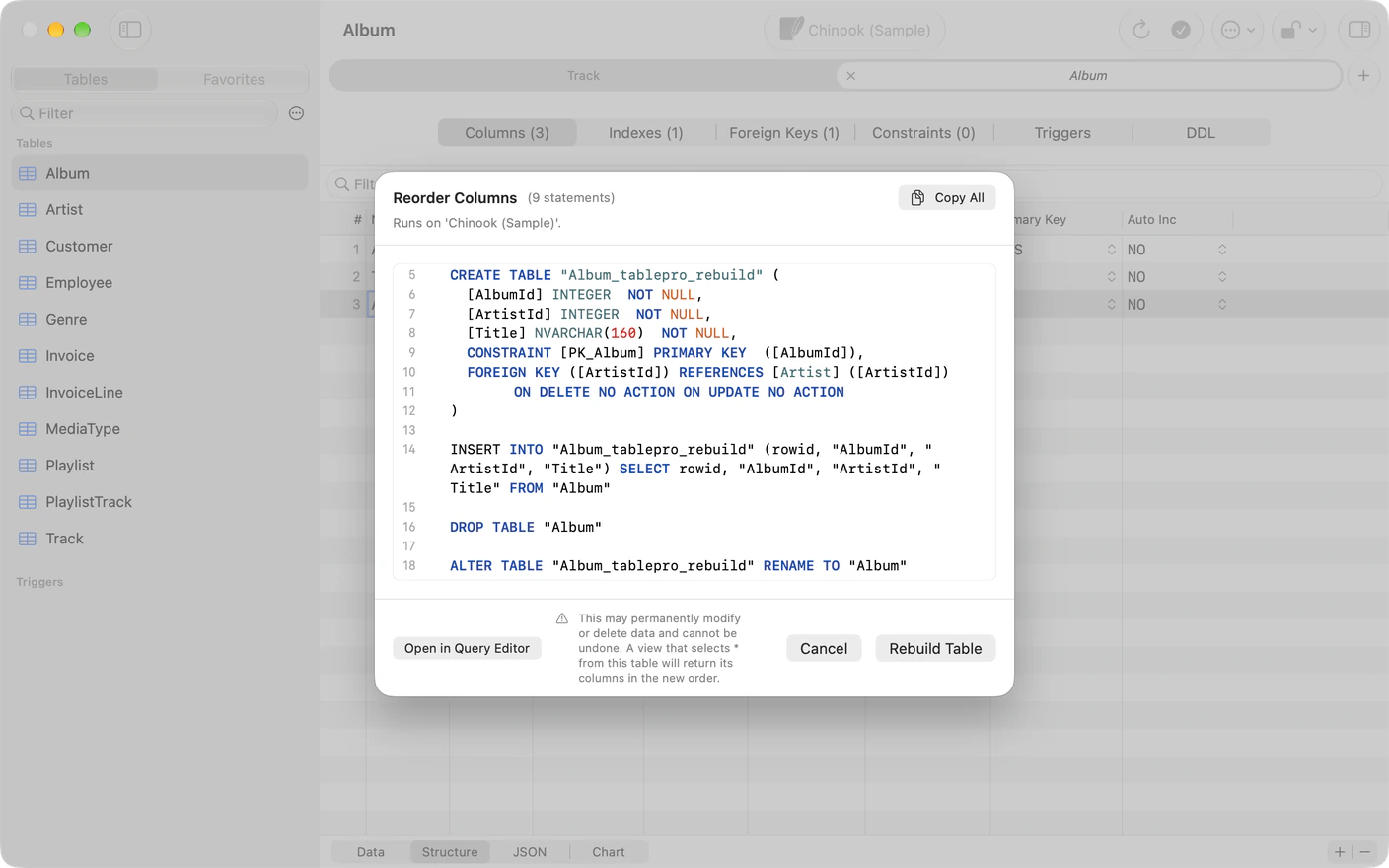
Move Column Up and Move Column Down are on the column's right-click menu for the same thing without the drag. On an engine that cannot reorder at all, the row number carries the reason instead of the menu going quiet.
Copy a database to another connection
#Copy To… and Duplicate Database… are in the Database menu and on the sidebar's right-click menu. Pick a target connection, database or schema and TablePro carries the structure, the data, or both.
The target does not have to be the same server, or the same engine's other instance. The picker it shares with Compare & Sync now has a search field, which matters once you have more connections than fit on screen.
Also new
#- TablePro recognises SQLite and DuckDB databases by their contents rather than their name, so a file called
data.binstill opens. .parquetfiles are in Finder's Open With, read through DuckDB, and File > Open File… opens anything TablePro reads.- A file that needs a driver you do not have prompts to install it before opening.
- The tab strip can wrap onto more rows instead of scrolling, in Settings > General > Tabs. Dragging a tab now autoscrolls, and Move Tab to New Window pulls one out.
- The connections strip leads with the connection name and puts the database or schema underneath.
UpandDownwhile editing a cell move the editor to the same column of the row above or below.- Korean, Turkish, Vietnamese and Chinese translations for 742 strings that had been shipping in English.
What it will not do
#The MongoDB shell cannot be interrupted mid-script. JavaScriptCore's execution time limit is private and absent from the SDK headers, so cancellation happens when a script next calls into the driver, which covers every script that touches the database. One that spins without touching it is abandoned after 120 seconds of silence rather than left able to block the next run.
Foreign key expansion needs a foreign key declared in the schema. A relationship you keep by convention is not one TablePro can follow.
A table rebuild is a rebuild. On PostgreSQL, SQLite, libSQL, Turso and Cloudflare D1, reordering columns copies every row of the table, and the script is shown rather than hidden because that is a cost you should agree to on a large table.
Getting it
#TablePro > Check for Updates, or download it.
If you use MongoDB, Oracle, MSSQL, LibSQL or Cloudflare D1, update those plugins too. The shell and the column reorder ship in the driver. Turso runs on the libSQL plugin, so that is the one to update for it.
The full changelog has all 58 entries.
Related pages
Full release notes
Available for Mac, iPhone and iPad.
Download for Mac